
By FormNCut | 9 min read
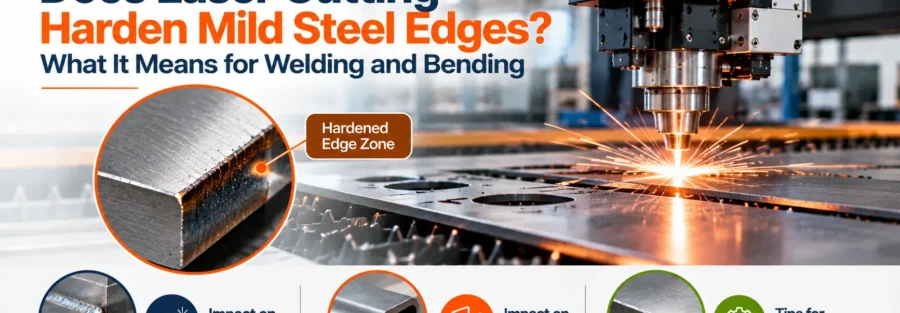
Yes, but only in a very thin layer. A steel laser cutting machine melts and rapidly cools a fraction of a millimetre at the cut face, which can leave a harder recast layer and, with oxygen cutting, an oxide skin. Just behind that, the heat affected zone of mild steel often softens slightly rather than hardens. In practice, the oxide skin causes most welding and painting problems, and the hard edge only causes trouble on tight bends where the cut edge sits on the outside of the bend.
Key insights
- The hard layer is thin: it sits right at the cut face, usually well under a millimetre deep.
- Mild steel’s heat zone often softens: one study found up to 9.4% lower hardness 2 mm from the cut.
- Oxide, not hardness, troubles welders: oxygen-cut edges carry a scale that can cause porosity and poor paint adhesion.
- Gas choice is the main fix: nitrogen or air cutting leaves a clean, oxide-free edge that welds and paints without grinding.
Before you go
If your welders are grinding every laser-cut edge before welding, ask why. Usually the answer is oxide from oxygen cutting, and the cheaper fix is a change of assist gas on the parts that get welded, not more grinding time.
Do you know why fabricators argue about laser-cut edges? It’s because two different things happen at the same edge, and people blame one for the other. The very face of the cut changes, and the steel a few millimetres behind it changes differently. So what this means is that “the laser hardens the edge” is partly true and partly misleading.
You might not be aware, but on ordinary structural mild steel, the bigger practical issue is often not hardness at all. It’s the thin oxide skin left by oxygen cutting, which is what gets in the way of a clean weld or a lasting paint finish.
This guide explains what laser cutting does to a mild steel edge, when it matters for welding and bending, and the settings and gas choices that keep laser-cut parts trouble-free downstream.
What actually happens to a mild steel edge during laser cutting?
The laser melts a narrow kerf, the assist gas blows the molten metal out, and the thin film left on the cut face solidifies and cools very quickly. That leaves three layers: a recast layer at the face, a heat affected zone behind it, and unchanged base metal beyond.
The recast layer
This is the metal that melted and re-solidified on the cut face. It cools fast, which can make it harder than the base metal, and on oxygen cuts it’s topped with an oxide skin.
The heat affected zone
Behind the face, the steel got hot but didn’t melt. One study of 6 mm ASTM A36 mild steel found that the heat affected zone extended about 4 to 6 mm from the cut, with hardness up to 9.4% lower at 2 mm, returning to base hardness by 25 mm. The authors linked this softening to grain coarsening and ferrite formation from slower cooling.
Why both can be true
So what this means is that the very face can be harder while the zone behind it is slightly softer. Research on laser cutting zones has shown local increases in hardness and residual stress in the cutting zone that depend on laser power, which is why the effect varies with settings.
| Layer | Depth from cut face | What changes | Practical effect |
| Oxide skin (oxygen cuts) | Very thin surface film | Iron oxide scale | Weld porosity, paint flaking |
| Recast layer | Typically well under 1 mm | Can be harder than base metal | Edge cracking on tight bends |
| Heat affected zone | A few mm | Often slight softening in mild steel | Rarely a problem in fabrication |
| Base metal | Beyond the HAZ | Unchanged | None |
Why does the assist gas change everything?
The assist gas decides whether the edge carries an oxide skin. Oxygen burns with the steel and adds heat, which cuts thick mild steel quickly but leaves a dark oxide layer. Nitrogen and compressed air shield the cut, leaving a bright, largely oxide-free edge that welds and paints cleanly.
Oxygen cutting
Oxygen is the traditional choice for thicker mild steel because the reaction adds energy and speeds up the cut. However, the price is a scaled edge that may need grinding before welding or painting.
Nitrogen cutting
Nitrogen produces a clean edge with no oxide, which is why it’s the standard for stainless steel. The thing to note here is that it needs more laser power and higher gas pressure on thick sections, so it costs more per metre.
Compressed air cutting
Air is a middle path on thin and medium mild steel, giving a cleaner edge than oxygen at a lower gas cost than nitrogen. Moreover, for many sheet metal parts it’s the most economical option.
| Assist gas | Edge finish on mild steel | Weld and paint readiness | Running cost |
| Oxygen | Dark, oxidised | Often needs grinding | Low gas cost, fast on thick plate |
| Nitrogen | Bright, oxide-free | Ready without grinding | Higher gas and power cost |
| Compressed air | Light, mostly clean | Usually ready on thin sheet | Lowest overall on thin material |
Does a laser-cut edge cause welding problems?
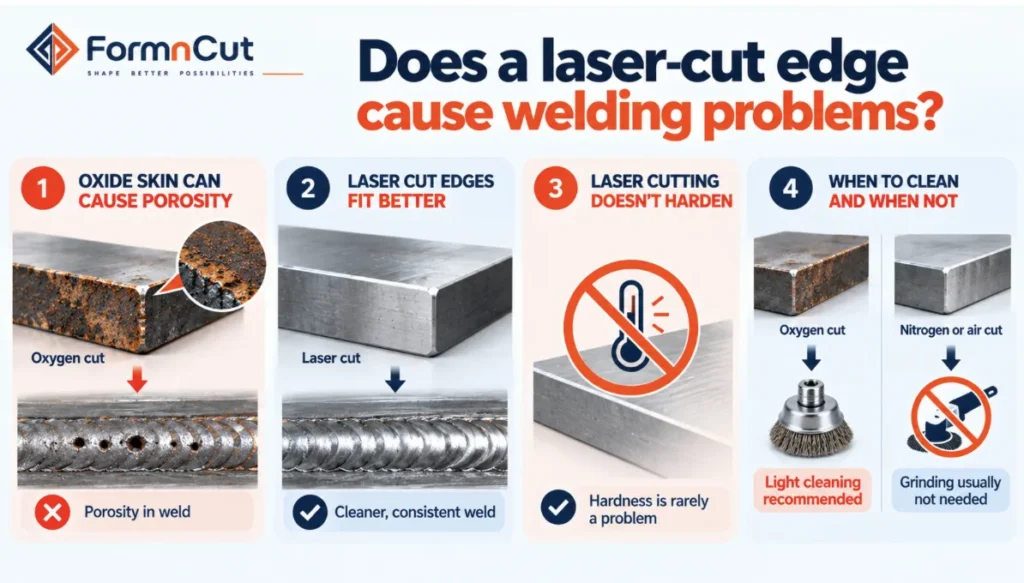
A laser-cut edge rarely causes welding problems because of hardness. The usual culprit is the oxide skin from oxygen cutting, which can trap gas and cause porosity, especially in MIG and TIG welds on thin material. Cutting with nitrogen or air, or lightly cleaning oxygen-cut edges, prevents it.
Porosity from oxide
Iron oxide on the weld joint can release gas and contaminate the weld pool. It is recommended that you test a few joints from oxygen-cut parts before committing a full batch to welding without cleaning.
Fit-up is usually better
Laser-cut parts often fit together more accurately than sawn or plasma-cut parts. Moreover, a tighter, more consistent gap makes welding faster and reduces filler use, which is a real benefit that’s easy to overlook.
When to grind and when not to
If the parts are oxygen-cut and going for high-quality TIG welding or powder coating, light cleaning is worth it. However, if the parts are cut with nitrogen or air, grinding is usually wasted time.
Can a laser-cut edge crack during bending?
Yes, occasionally. When a bend line runs across a laser-cut edge, the cut edge sits on the outside of the bend and is stretched hardest. If the recast layer is hard and the bend is tight, small cracks can start at that edge. On mild steel, this is uncommon at normal bend radii but more likely on tight radii and thicker plate.
Where cracks start
Cracks begin where the edge meets the outer surface of the bend, because that’s where the strain is highest. You might not be aware, but small notches or dross on the edge make this worse by giving the crack a starting point.
Bend radius matters most
A bend radius of at least the material thickness is a common rule of thumb for mild steel. Moreover, tighter radii on thick plate leave less margin for any edge defect.
Grain direction
Bending across the rolling direction of the sheet is more forgiving than bending along it. It is important for you to know that nesting parts so critical bends run across the grain can cut edge-cracking problems without changing anything else.
| Bending risk factor | Raises crack risk | Lowers crack risk |
| Bend radius | Tighter than material thickness | At least equal to thickness |
| Edge condition | Dross, notches, rough striations | Clean, smooth cut face |
| Grain direction | Bend line along rolling direction | Bend line across rolling direction |
| Assist gas and settings | Excess heat, slow cutting | Optimised speed and power |
| Material thickness | Thicker plate | Thinner sheet |
How do you set up laser cutting for parts that will be welded or bent?
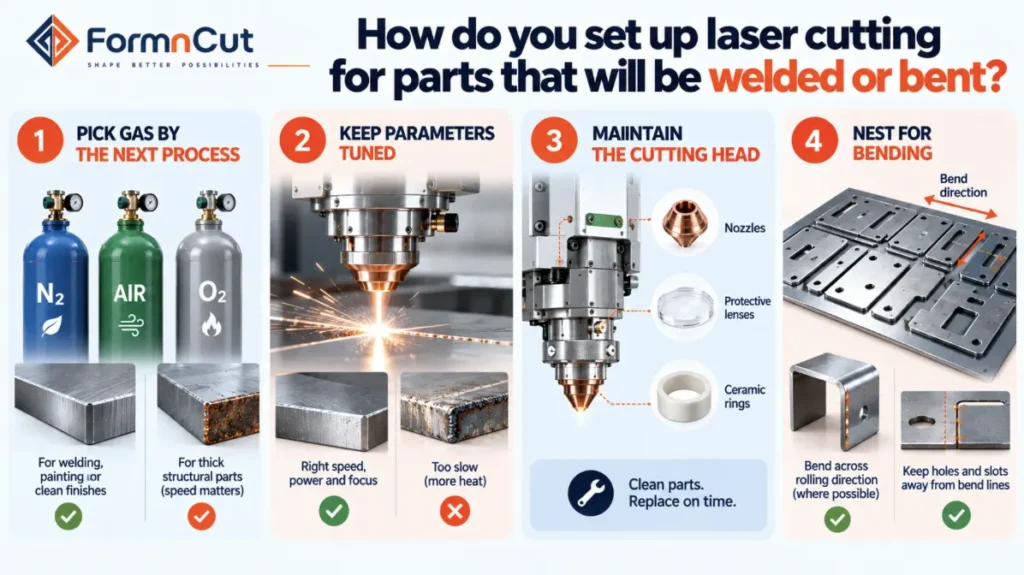
Choose the assist gas by what happens next, keep the cutting parameters optimised so the edge is smooth and the heat input is controlled, maintain the nozzle and optics, and nest parts with bend direction in mind. These four habits remove most downstream edge problems.
Pick gas by the next process
Use nitrogen or air for parts going to welding, painting or visible finishes. Moreover, keep oxygen for thick structural parts where speed matters and the edge will be cleaned or hidden.
Keep parameters tuned
Cutting too slowly puts extra heat into the edge and widens the affected zone. The thing to note here is that the right speed, power and focus for each thickness give a smoother face and a thinner recast layer.
Maintain the cutting head
A worn nozzle or dirty protective window disturbs the gas flow and beam, leaving rougher edges and more dross. Spare nozzles, ceramic rings and protective lenses are cheap compared with rework, and FormNCut supplies cutting head and optics accessories for that routine replacement.
Nest for bending
Program the nest so critical bends run across the rolling direction where the part allows it. Moreover, keep features like holes and slots a sensible distance from bend lines.
What about stainless steel edges?
Stainless steel is normally cut with nitrogen, so it doesn’t get the oxide skin that mild steel gets with oxygen. Its cut edge can still show a hardened layer, and some grades work-harden readily, so tight bends across cut edges deserve the same care as on mild steel.
Clean edges for welding
Nitrogen-cut stainless steel edges are generally weld-ready. That’s one reason a stainless steel laser cutting machine is set up for high-pressure nitrogen as standard.
Corrosion resistance
An oxide-free edge helps stainless steel keep its corrosion resistance at the cut. It is recommended that you avoid oxygen on stainless parts that will be exposed to moisture or food contact.
Bending stainless
Stainless needs a little more care in bending because of springback and work hardening. Moreover, a smooth cut edge matters even more here.
How does the right machine reduce edge problems?
A well-built fiber laser with stable motion, good beam quality, the right gas delivery and an accurate height sensor produces smoother, more consistent edges, which reduces both weld preparation and bend cracking. Consistency matters as much as peak quality, because problems usually come from the occasional bad part, not the average one.
Stable cutting across the sheet
A rigid machine frame and accurate motion keep the cut quality the same at the corner of the sheet as at the centre. The Marut range of sheet cutting machines is built for stainless steel, aluminium, brass and mild steel, with cutting areas from 3000 x 1500 mm to 6000 x 1500 mm.
Cutting and bending together
When cutting and bending are planned together, nests can be optimised for bend direction from the start. FormNCut builds both, including CNC press brake machines with automatic compensation for slider deformation.
Support that keeps settings right
The cutting parameters for each material and thickness need tuning when a machine is installed and checked as consumables wear. Moreover, local support that can fine-tune those settings is part of getting good edges every shift.
Wrapping up
Laser cutting does change the edge of mild steel, but the change is thin, and the slightly softer heat zone behind it is rarely a problem. The issues fabricators actually see are oxide from oxygen cutting, which affects welding and painting, and edge cracking on tight bends. Choose the gas by what happens next, keep parameters and consumables in good shape, and nest with bend direction in mind. To see how a fiber laser setup would handle your parts, contact our team for a sample cut and a gas recommendation.
FAQs
Does laser cutting make steel harder?
Laser cutting can leave a thin, harder recast layer right at the cut face. Behind it, the heat affected zone of mild steel often softens slightly. Overall, the change is shallow and rarely affects ordinary fabrication.
Why do laser-cut edges need grinding before welding?
Usually because the parts were cut with oxygen, which leaves an oxide skin that can cause weld porosity and poor paint adhesion. Parts cut with nitrogen or compressed air typically don’t need grinding.
Can laser-cut mild steel crack when bent?
Occasionally, yes. Cracks can start at a laser-cut edge on the outside of a tight bend. Using a bend radius at least equal to thickness and bending across the grain usually prevents it.
Is nitrogen or oxygen better for cutting mild steel?
Oxygen cuts thick mild steel faster and cheaper but leaves an oxidised edge. Nitrogen leaves a clean, oxide-free edge ready for welding and painting, at higher gas and power cost. Choose by the next process.
How deep is the heat affected zone in laser-cut mild steel?
One study on 6 mm ASTM A36 mild steel found the heat affected zone extended about 4 to 6 mm from the cut, with hardness back to base level by 25 mm.
Does stainless steel get an oxide layer when laser cut?
Not when it’s cut with nitrogen, which is the standard for stainless steel. Nitrogen shields the cut and leaves a bright, oxide-free edge that keeps the material’s corrosion resistance and is ready for welding.