

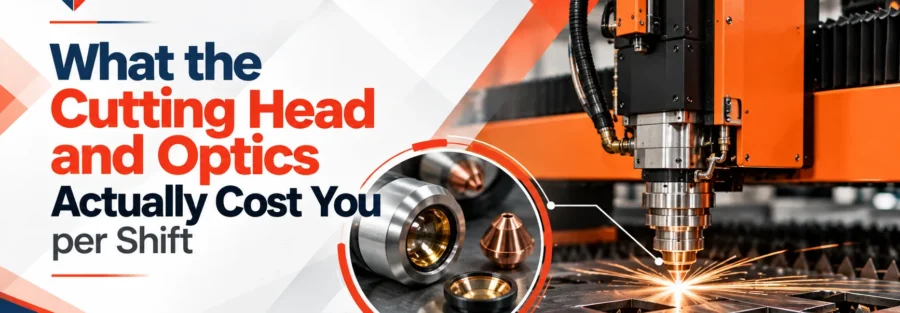
The laser tube cutting machine price on a quotation is the capital number. The number that decides whether the machine earns is the running cost per shift, and most of it sits in four places: assist gas, electricity, cutting head consumables and the labour lost when one of them fails mid-job. Nozzles and protective lenses are cheap individually and expensive in aggregate.
Nobody negotiates hard on consumables at the point of purchase. Everybody notices them in month seven.
This is an attempt to put honest structure around the running cost, so the machine you buy is the one you can afford to operate.
Which parts wear, and how fast?
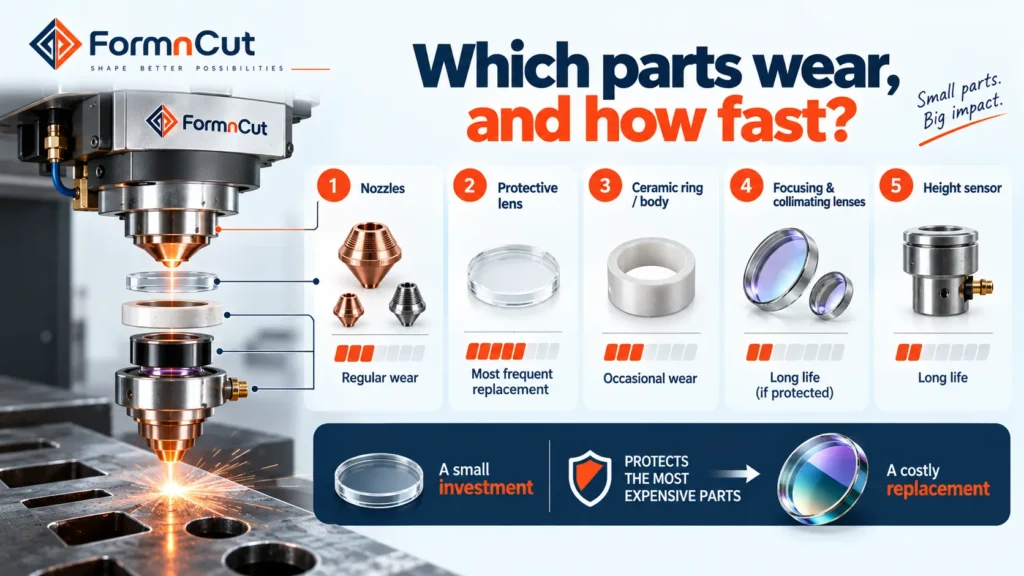
The cutting head is where the beam meets the work, and it is the only assembly on the machine that is genuinely consumable.
- Nozzles direct the assist gas. Single layer, double layer and high pressure types suit different materials and pressures. They wear, they get struck by spatter, and a damaged nozzle changes gas flow before anyone notices the cut has changed.
- Protective lens. The sacrificial glass between the optics and the process. It exists to be destroyed instead of the focusing lens above it. This is the most frequently replaced item in the head.
- Ceramic ring or body. Carries the height sensing circuit. Cracks on collision.
- Focusing and collimating lenses. Long life if the protective lens is doing its job, expensive if it is not.
- Height sensor. Holds stand-off distance through the cut.
The economics run in one direction. The protective lens is the cheapest part in that list and the one that protects the most expensive parts. A shop that stretches protective lens life to save money is gambling a focusing lens against it.
Why does assist gas cost more than people budget?
Because pressure gets turned up for reasons that stop working above a certain point.
A review of assist gas behaviour in laser cutting found that a threshold gas pressure is required to avoid dross, but a further increase in pressure does not significantly improve edge quality. Above the threshold you are buying nitrogen and getting nothing back.
That is a very common way to lose money quietly. An operator sees a poor edge, raises the pressure, the edge does not improve, and the pressure stays up for the next six months because nobody turned it back down.
Gas is a per-hour cost that runs whenever the machine runs. Getting the pressure right once is worth more than negotiating a better rate on the cylinder.
What does the energy side actually look like?
Measurable, and worth measuring.
A study of laser processing of Hardox 400 put total energy consumption at 9.09 euro per hour, and found cutting speed to be the dominant factor at roughly 88.5 per cent of the cutting efficiency outcome. The absolute figure will differ on your tariff and your material. The relationship will not.
Cutting faster at the correct parameters lowers cost per part on every axis at once: less machine time, less gas, less electricity, more parts per shift. Cutting slowly to be safe is expensive in four ways simultaneously.
How should a shop actually track this?
Per shift, on one sheet, in five lines.
| Line item | How to capture it | Why it matters |
| Protective lenses used | Count per shift | Rising count means spatter, focus or gas problems upstream |
| Nozzles replaced | Count and reason | Collision damage is a programming issue, not a consumables issue |
| Assist gas consumed | Cylinder or flow meter | Should track machine hours, not operator preference |
| Machine hours vs beam-on hours | Controller log | The gap is handling, and handling is where output hides |
| Unplanned stops | Log cause | A head failure mid-job costs the changeover plus the scrapped part |
The point of the sheet is not accounting. It is that consumables are a diagnostic. A protective lens count that doubles in a month is telling you something changed upstream, and finding it costs less than absorbing it.
Keeping the wear items in stock is the other half. A machine stopped waiting for a nozzle costs more in an afternoon than a year’s stock of nozzles. The cutting head and optics accessories range covers fibre laser cutting heads, single layer, double layer and high pressure nozzles, ceramic rings, protective lenses, collimating and focusing lenses, nozzle holders and height sensors.
What should you ask before you sign?
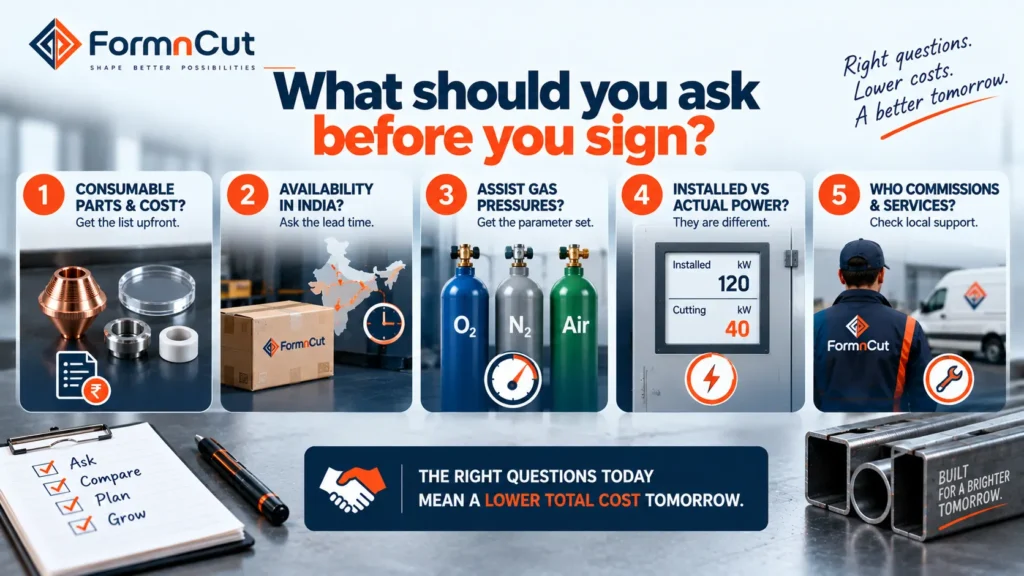
Five questions that change the real cost more than the headline figure.
- What are the consumable part numbers and what do they cost? Get the list before purchase, not after.
- Are they available in India, and how quickly? Lead time on a protective lens is a production question.
- What assist gas pressures do the standard programs use? Ask for the parameter set, not a demonstration.
- What is the installed power draw, and what is the actual draw while cutting? These are different numbers.
- Who commissions the machine and who services it? Distance to the nearest engineer is a running cost.
A supplier that answers all five plainly is telling you something about how the next five years will go.
Supported from Thane, not from a call centre
FormNCut is a brand of Stamp’IT Robotai & Solutions Pvt. Ltd., an ISO 9001:2015 certified manufacturer at Wagle Industrial Estate, Thane, with more than fifty years of group engineering behind it and customers in over 40 countries. The group built its reputation on marking and traceability equipment through MarknStamp before launching FormNCut for laser cutting in 2025.
Consumables, spares and service come from the same organisation that builds the machine, alongside the wider laser cutting machine accessories range covering fibre laser sources, cooling and gas systems, exhaust, electrical control and maintenance parts.
Running cost depends on your material, your thickness range and your shift pattern, so a general figure is not much use to anybody. Send across what you cut and how many hours a week you cut it, and talk to an engineer about what the machine would actually cost you to run.
Frequently asked questions
How often does a protective lens need replacing?
It varies with material, thickness, spatter and how clean the process is, so track your own count per shift. A sudden rise in replacements usually points to a problem upstream rather than to the lens itself.
Does a higher laser power always cost more to run?
Not per part. Higher power often cuts faster, which lowers machine time, gas and electricity per part. Cost per part matters more than cost per hour when comparing machines.
Which nozzle type should I use?
Single layer, double layer and high pressure nozzles suit different materials and assist gas pressures. The machine’s parameter set should specify which, and deviating from it usually costs edge quality.
Is the laser tube cutting machine price the main cost to consider?
No. Capital is one number. Assist gas, electricity, consumables, spares availability and service response together decide what the machine costs across its life, and they are easier to negotiate before purchase.
Can I use third party consumables?
You can, and quality varies considerably. A cheap protective lens that fails early can damage the focusing lens behind it, which turns a small saving into a large repair.
The machine that looks cheapest on the quotation is not always the one that is cheapest to run, and the difference shows up in a line item nobody discussed at the demonstration. Check the FormNCut accessories range and talk to an engineer about what your parts and your shift pattern would actually cost.