
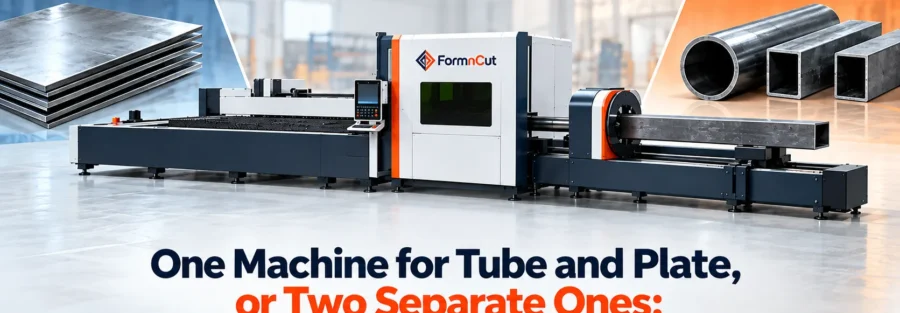
A tube and plate integrated tube cutting machine handles both on one bed, one control and one laser source. Two dedicated machines cut faster on each job but need twice the floor, twice the capital and enough work to keep both busy. For a small shop the decision comes down to one number: how many hours a week each machine would actually run.
This is the question that gets answered emotionally more often than arithmetically. Everyone wants two machines. Very few small shops have the order book to justify the second one in year one.
So work it out properly, because the wrong answer in either direction is expensive.
What does an integrated machine actually give up?
Less than most people assume, and it is worth being specific about what.
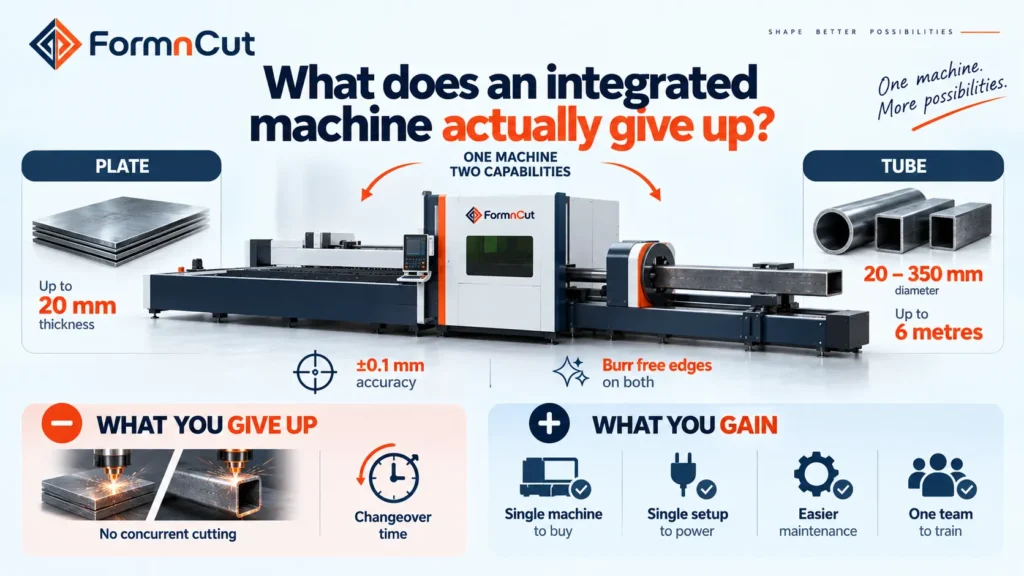
An integrated system carries both a flat bed and a tube chuck, sharing one fibre source and one CNC. On the FormNCut tube plate integrated range, the same machine covers plate up to 20 mm thickness and tube from 20 mm to 350 mm diameter at up to six metres, holding plus or minus 0.1 mm accuracy with burr free edges on both.
What you give up is concurrency. The machine cuts tube or plate, never both at once, and switching between them costs changeover time. On a shop where tube and plate jobs alternate through the day, that changeover is the real cost, not any loss of cut quality.
What you gain is a single machine to buy, house, power, maintain and train people on.
How busy would the second machine really be?
This is the number that decides it, and most shops guess it high.
Indian manufacturing capacity utilisation, measured quarterly by the Reserve Bank, reached 77.4 per cent in March 2026 against a long-run average of 74.6 per cent. That is a healthy figure at national level. Applied to a single capital machine in a small shop, it means roughly a quarter of its available hours produce nothing.
Now split your work. If tube is 70 per cent of your volume and plate is 30 per cent, a dedicated plate machine runs at well under half the utilisation of the tube machine beside it. You have bought two assets and you are financing one of them out of the other’s margin.
The threshold to look for is not a percentage. It is whether each machine independently has enough committed work to cover its own instalment.
What does the capital picture look like in India right now?
Worth knowing before you negotiate, because it affects lead times and pricing.
Indian machine tool consumption reached INR 36,419 crore in FY26, while domestic production was INR 17,387 crore against imports of INR 21,628 crore. More than half of what Indian factories buy comes from abroad, mostly from China, Japan and Germany.
That matters to a small shop in two practical ways. Imported machines carry longer lead times and currency exposure on spares. And when something fails, the difference between an engineer in Thane and an engineer in another time zone is measured in days of lost production.
Which way should you go?
Four questions, answered honestly, settle it.
| Question | Points to integrated | Points to two machines |
| Tube to plate split | Anything other than roughly even | Close to 50:50 both fully loaded |
| Floor space | Constrained | Space available and cheap |
| Shift pattern | Single shift | Two or three shifts |
| Job changeover frequency | A few changeovers a day | Constant switching between tube and plate |
| Capital position | First laser, financing tight | Replacing an existing machine, order book committed |
If most of your ticks land in the left column, buy one machine and buy it with capacity to grow into.
The genuine exception is the shop switching between tube and plate many times a day. There, changeover time on an integrated machine eats the saving, and two machines earn their keep even at lower individual utilisation.
What is the mistake shops actually make?
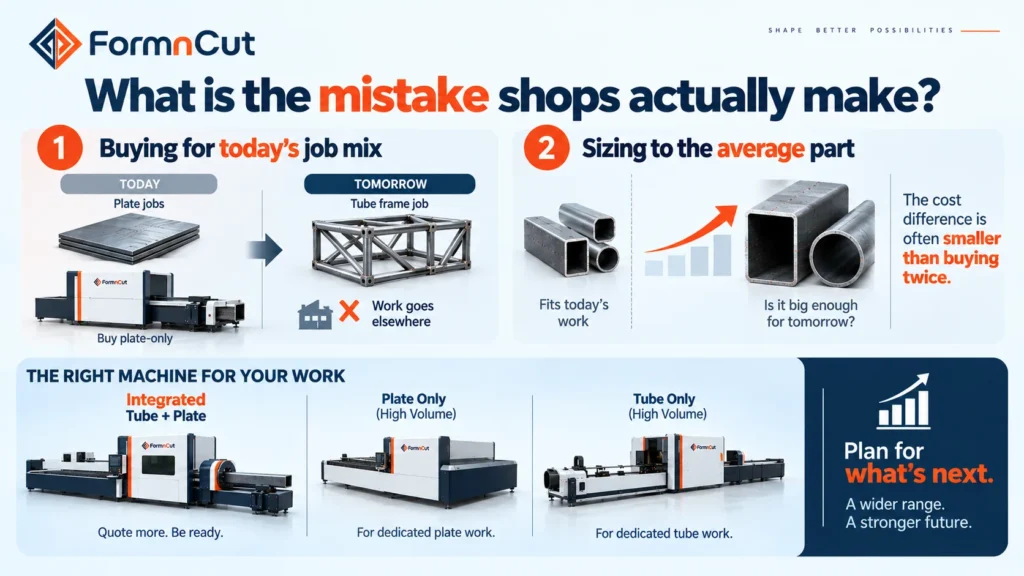
Buying for today’s job mix.
The shop that buys a plate-only machine because plate is what it cuts now discovers within eighteen months that a customer wants a welded tube frame, and the work goes elsewhere. The shop that buys integrated can quote that job on the machine it already owns.
The second mistake is sizing to the average part instead of the largest one. The tube plate integrated range runs from FTC-3015 at 3000 x 1500 mm through to FTC-8025 at 8000 x 2500 mm, and the difference between the model that fits your current work and the one that fits your work in three years is usually smaller than the cost of buying twice.
Where volume genuinely justifies dedicated equipment, the precision fibre laser cutting machine and the tube ranges exist separately for exactly that reason.
Built and supported from Thane
FormNCut is a brand of Stamp’IT Robotai & Solutions Pvt. Ltd., an ISO 9001:2015 certified Indian manufacturer at Wagle Industrial Estate, Thane, with over five decades of group engineering behind it and customers across more than 40 countries. The group has been building marking and automation equipment since long before it launched FormNCut for laser cutting in 2025.
Being an Indian manufacturer matters most on the day a machine stops. Installation, commissioning, spares and service run from Thane rather than from an overseas parent, and the same team that built the machine supports it.
Every shop’s mix of tube and plate is different, and the answer changes with your order book rather than with a general rule. Send across your monthly job mix and your shift pattern, and talk to an engineer about which configuration your numbers actually support.
Frequently asked questions
Can one machine really cut both tube and plate well?
Yes. A tube plate integrated tube cutting machine carries both a flat bed and a tube chuck on one CNC, cutting plate to 20 mm and tube from 20 mm to 350 mm diameter, at plus or minus 0.1 mm on both.
How long does changeover between tube and plate take?
It depends on the configuration and the operator, and it is the main practical cost of an integrated machine. Shops usually batch tube jobs and plate jobs to reduce how often changeover happens.
Is an integrated machine cheaper than two separate ones?
Almost always on capital, floor space, power and training. Whether it is cheaper in operation depends entirely on how often you switch between tube and plate work.
What size should a small shop buy?
Size to the largest part you realistically expect within three years, not to today’s average. Upgrading later costs far more than specifying one model larger at the outset.
Do I need three phase power and a chiller?
Yes. These machines run an integrated chiller for stable performance, plus exhaust and dust extraction, and site preparation should be discussed before the order rather than after delivery.
The shop that gets this right is not the one that buys the most machine. It is the one that is honest about how many hours a week the second machine would sit idle. Check the FormNCut range and talk to an engineer about your job mix before you size anything.