


By FormNCut | 9 min read
A laser tube cutting machine is usually faster per finished part and more accurate than traditional pipe cutting, because it cuts length, holes, slots and end profiles in one clamping. A bandsaw or cold saw can still be faster for plain cut-to-length work on simple tube. Accuracy is where the gap is widest: a laser positions every feature from one datum, while traditional methods stack up small errors at each separate setup.
Key insights
- Measure speed per finished part, not per cut: a saw cuts faster, but the part isn’t finished when it leaves the saw.
- Accuracy suffers at every re-clamp: each separate setup adds its own error, and those errors add up.
- One datum, one tolerance: a laser holds every feature to the same reference, typically around ±0.1 mm.
- Saws still win on plain lengths: straight cut-to-length of simple stock remains a sawing job in many shops.
Before you go
Pick your three most common tube parts and time them from raw stock to ready-for-welding, including marking, drilling, notching and deburring. Then ask for the same three parts to be laser cut. That comparison, on your own parts, is the only speed figure that matters.
Do you know why two fabricators can disagree completely on whether laser tube cutting is faster? It’s because one is timing the cut and the other is timing the part. A saw blade goes through a tube in seconds, and a laser may take a little longer on the same straight cut. However, the sawn tube still needs marking, drilling, notching and deburring, and the lasered one usually doesn’t.
You might not be aware, but accuracy follows the same logic. Each extra machine a part visits adds another clamping, another measurement and another chance for a small error to creep in.
This guide scores laser tube cutting and traditional pipe cutting on speed and accuracy separately, shows where each one wins, and explains how to work out which is faster for your own parts.
Is laser tube cutting actually faster?
Laser tube cutting is faster per finished part whenever the tube needs any feature beyond a straight cut, such as holes, slots, notches, copes or markings. For plain cut-to-length work on simple stock, a good saw can match or beat it, so the honest answer depends on what your parts look like.
Speed per cut
On a straight cut through round or square tube, a saw is quick. However, a modern fiber laser is also fast on thin and medium wall tube, and it doesn’t slow down as the blade wears.
Speed per finished part
The real comparison includes everything after the cut. Moreover, every operation that disappears, whether that’s marking, drilling, notching or deburring, also removes the handling and waiting time between machines.
Published results
One case study of a rotary laser on farm-equipment tube reported a 40 percent saving in process cycle time on a part whose holes previously needed four drilling setups. So what this means is that the time saving comes mostly from the setups that were removed, not from the cut itself.
| Part type | Faster method | Why |
| Plain cut-to-length, simple stock | Saw | Fast straight cut, low cost per cut |
| Cut-to-length plus a few holes | Laser | Removes drilling and marking setups |
| Notched or coped ends for welding | Laser | Removes notching and fitting work |
| Complex profiles, slots, tabs | Laser | Traditional methods need several machines |
| Very thick-wall large-diameter pipe | Often saw | Laser time grows with wall thickness |
Where does traditional pipe cutting still win?
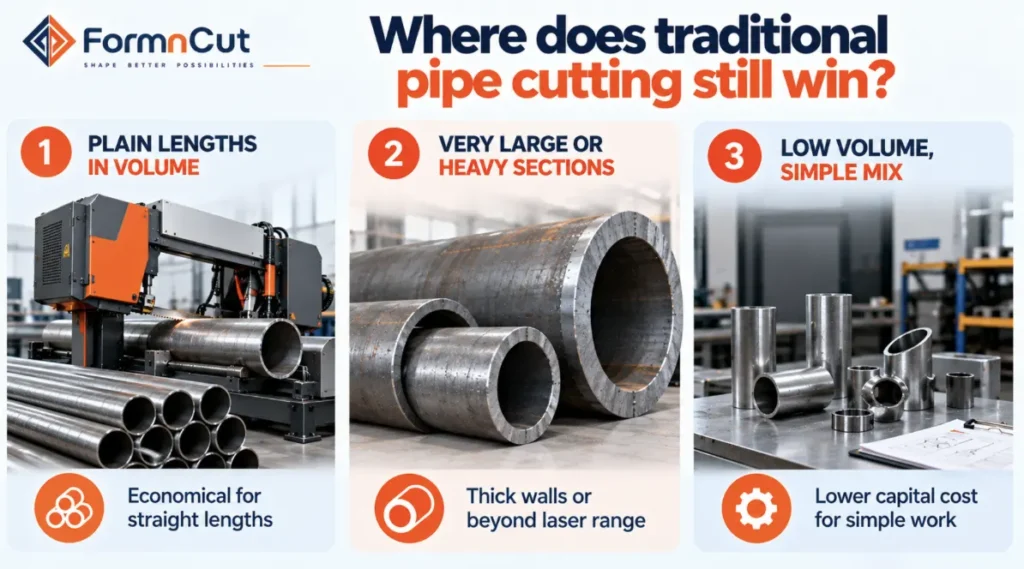
Traditional pipe cutting wins on plain, high-volume cut-to-length work, on very thick-walled or very large-diameter pipe beyond a laser’s range, and in shops where the capital cost of a laser can’t be justified by the part mix. A bandsaw is cheap to buy, simple to run and very good at doing one thing.
Plain lengths in volume
If your work is mostly straight lengths with no features, a saw is the economical choice. It is recommended that you keep a saw for this work even after buying a laser, because it frees laser time for the parts that need it.
Very large or heavy sections
Pipe beyond a laser’s diameter range or with very thick walls is often better sawn. Moreover, cutting very thick wall slowly on a laser can tie up a machine that’s more valuable on thinner, more complex parts.
Low volume, simple mix
A small shop cutting a few simple parts a week may not use a laser enough to justify it. However, outsourcing laser work for the occasional complex part is a sensible middle path.
Why is laser tube cutting more accurate?
A laser is more accurate because it cuts every feature from a single clamping and a single datum, so the hole, the slot and the end cut are all positioned relative to the same reference. Traditional cutting moves the tube between machines, and each move adds a small positioning error.
The single datum
When a tube is clamped once and every feature is cut in the same program, the features stay in the right place relative to each other. The thing to note here is that relative accuracy, hole to hole and hole to end, is what decides whether parts fit at welding.
Tolerance stack-up
Each separate operation has its own tolerance. If cutting, marking and drilling each add a small error, the total can be several times larger than any one of them. Moreover, the errors don’t always cancel; sometimes they add.
Repeatability
A CNC program cuts the hundredth part the same as the first. By contrast, manual marking and drilling depend on the operator, and accuracy can drift over a shift.
| Accuracy factor | Laser tube cutting | Traditional (saw + drill + notch) |
| Number of clampings | One | Three or more |
| Reference datum | One for every feature | New reference at each machine |
| Typical feature accuracy | Around ±0.1 mm | Depends on each setup and operator |
| Error stack-up | Minimal | Errors add across operations |
| Repeatability over a batch | Program-controlled | Varies with operator and tooling wear |
How do you calculate which is faster for your parts?
Add up the time for every operation from raw stock to a part ready for welding, including handling and waiting between machines, then compare it with the laser cycle time for the same part. The difference, multiplied by your annual volume, tells you how much time a laser would save.
List every step
For each part, list cutting, marking, drilling, notching, deburring, inspection and any rework. Moreover, include the time parts spend waiting between machines, because it’s often the largest hidden delay.
Time the laser cycle
Ask for a laser cycle time on your actual part, including loading and unloading. It is important for you to know that automatic loading and unloading change the result a lot on long runs.
A simple worked example
Here’s how the comparison looks for a tube with an end cope and four holes, using illustrative times.
| Step | Traditional route (min) | Laser route (min) |
| Cut to length | 0.5 | Included in one program |
| Mark hole positions | 1.0 | Included |
| Drill four holes | 2.0 | Included |
| Cope or notch end | 1.5 | Included |
| Deburr | 1.0 | Usually not needed |
| Handling between machines | 1.5 | Loading and unloading only |
| Total per part | 7.5 | Around 1 to 2 |
These are illustrative figures, not measurements. Your own parts will differ, which is why the timing exercise is worth doing.
What does the switch change beyond speed and accuracy?
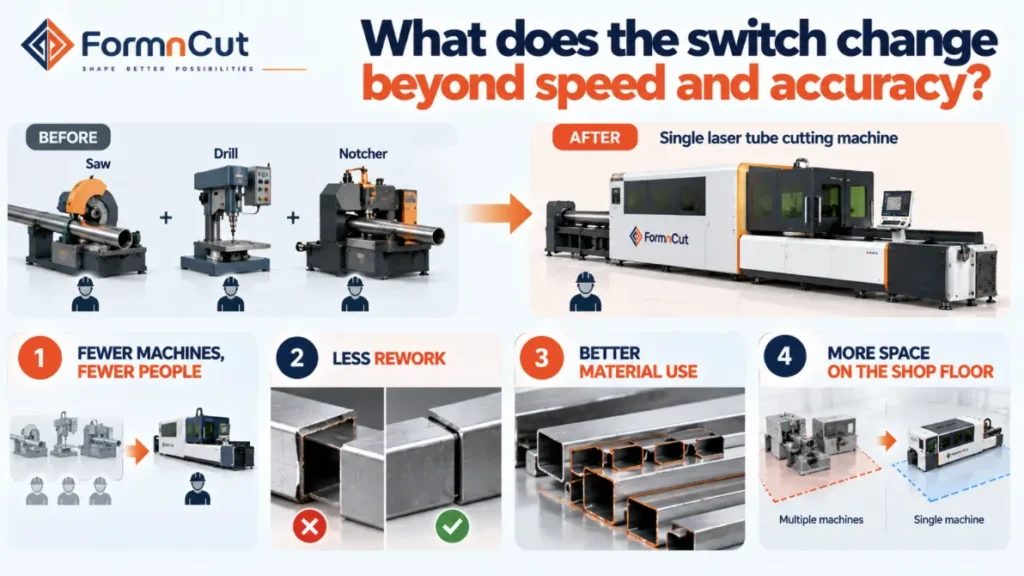
Switching to laser tube cutting also reduces floor space, operator count, rework and inventory between operations. A single machine replacing a saw, a drill and a notcher frees space and people, and better fit-up at welding saves time further down the line.
Fewer machines, fewer people
One laser can replace several manual stations. Moreover, operators who were drilling and notching can move to higher-value work like welding and assembly.
Less rework
Parts that fit first time don’t need grinding or re-drilling at the welding bay. You might not be aware, but rework at welding is often the largest cost that never gets traced back to the cutting method.
Better material use
Nesting parts along a tube reduces offcut waste. One stainless tube producer reported that a laser tube cutter increased output by 30% compared with its fastest sawing machine and saved 5% on operational costs, with the gain largest on stainless steel, where saw blades wear quickly.
Which laser tube cutting machine fits your work?
Choose by the tube sizes you cut, the lengths you buy, the volume you run, and whether you also cut flat sheet. Dedicated tube machines suit shops that are mostly tube; integrated tube and plate machines suit shops that do both.
Automatic pipe cutting
For production runs of round, square and rectangular tube, automatic loading and unloading keep the machine cutting. The Fiber Laser Automatic Pipe Cutting Machine handles diameters from 20 mm to 350 mm and lengths up to 6 m, with accuracy of ±0.1 mm.
Dedicated tube ranges
For a wider range of tube sizes, the Indra range of tube cutting machines runs from FTC-6012 to FTC-6052, with laser output options from 1,500 W to 6,000 W.
Tube and plate together
Shops that cut both tube and sheet can save space with the Fiber Laser Tube Plate Integrated Cutting Machine, which cuts plates up to 20 mm (material dependent) and tubes from 20 mm to 350 mm on one system.
Wrapping up
Laser tube cutting is faster per finished part and more accurate whenever your tubes need more than a straight cut, because it does everything in one clamping from one datum. A saw still wins on plain lengths and very heavy sections, and many shops keep both. Time your own parts from stock to weld-ready, compare the totals, and the right choice usually becomes obvious. If you’d like help running that comparison, send our team your most common tube drawings and we’ll talk through which machine fits.
FAQs
Is laser tube cutting faster than sawing?
Per finished part, usually yes, whenever the tube needs holes, slots, notches or copes. For plain straight cuts on simple stock, a saw can be as fast or faster and is cheaper to run.
How accurate is laser tube cutting?
Laser tube cutting is typically accurate to around ±0.1 mm, with every feature cut from a single datum in one clamping. That avoids the error stack-up of moving a tube between a saw, drill and notcher.
What is tolerance stack-up in pipe cutting?
Tolerance stack-up is the build-up of small errors across separate operations. When a tube is cut, marked, drilled and notched on different machines, each setup adds its own error, and the total can be much larger.
When should I still use a bandsaw for tubes?
Use a bandsaw for plain cut-to-length work in volume, for very thick-walled or large-diameter pipe beyond a laser’s range, and to free the laser for complex parts that need its accuracy.
Can a laser cut square and rectangular tubes?
Yes. Laser tube cutting machines cut round, square, rectangular and many custom profile tubes, including holes, slots and end profiles on every face of the tube, all in one program and one clamping.
Does laser tube cutting reduce welding time?
Often, yes. Accurate holes, copes and tab-and-slot features help parts fit first time and sometimes locate themselves in the right position, which reduces fixturing, grinding and rework at the welding stage.