
By FormNCut | 9 min read
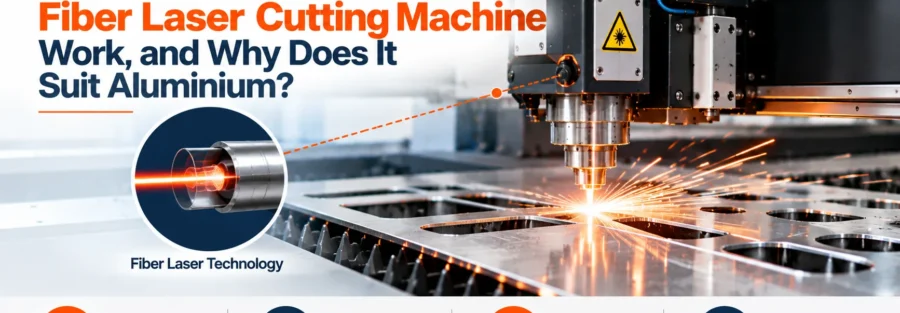
A fiber laser cutting machine works by generating a laser beam inside a doped optical fiber, carrying it through a flexible fiber cable to a cutting head, and focusing it to a tiny spot that melts the metal. A jet of assist gas blows the molten metal out of the cut, while a CNC system moves the head along the programmed path. As a laser cutting machine for aluminium, a fiber laser works far better than an older CO2 laser, because metals like aluminium absorb its shorter wavelength much more readily.
Key insights
- The beam is made inside a fiber: no mirrors or gas tubes to align, which keeps the machine compact and stable.
- The focus does the cutting: a small, intense spot melts metal along a narrow kerf.
- Gas finishes the job: nitrogen or air blows the melt out and keeps aluminium edges bright.
- Aluminium needs fiber: its reflectivity made it hard for CO2 lasers, but fiber lasers cut it routinely.
Before you go
If you’re comparing fiber lasers for aluminium work, ask each supplier to cut your actual part in your actual thickness and alloy, with nitrogen. The edge you see on that sample tells you more than any brochure figure.
Do you know why aluminium used to be the difficult metal in a laser shop? It’s because aluminium reflects a lot of light and conducts heat away fast, so older CO2 lasers struggled to get enough energy into it. Fiber lasers changed that, and today aluminium is cut every day on the same machines that cut steel.
You might not be aware, but the whole process happens in a fraction of a second at each point along the cut: the beam heats, the metal melts, the gas clears it, and the head moves on. Understanding those steps helps you understand what a machine’s specification actually means for your parts.
This guide walks through how a fiber laser cutting machine works, part by part, and then explains what changes when you’re cutting aluminium.
What are the main parts of a fiber laser cutting machine?
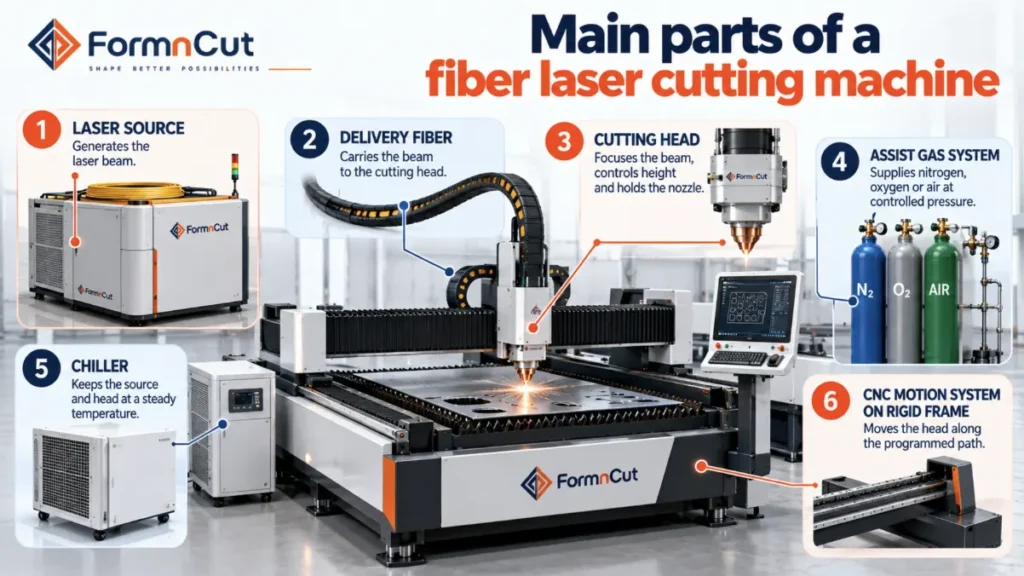
A fiber laser cutting machine has six main parts: the laser source, the delivery fiber, the cutting head, the assist gas system, the chiller, and the CNC motion system on a rigid frame. Each one affects cut quality, speed and running cost.
The laser source
This is where the beam is made. Inside, a length of optical fiber doped with a rare-earth element, usually ytterbium, is pumped with diode light and amplifies it into a powerful laser beam.
The delivery fiber
A flexible armoured fiber cable carries the beam from the source to the head. Moreover, because the beam travels inside the fiber, there are no mirrors to keep aligned as the gantry moves.
The cutting head
The head collimates and focuses the beam, holds the nozzle, and senses its height above the sheet. Its protective window and nozzle are consumables that need regular replacement.
Assist gas, chiller and CNC
The gas system supplies nitrogen, oxygen or compressed air at controlled pressure. The chiller keeps the source and head at a steady temperature, and the CNC system moves the head along the programmed path.
| Part | What it does | What it affects |
| Laser source | Generates the beam | Power available for thickness and speed |
| Delivery fiber | Carries the beam to the head | Stability, no mirror alignment |
| Cutting head | Focuses the beam, controls height | Kerf width, edge quality |
| Assist gas system | Blows out molten metal | Edge finish, oxide or no oxide |
| Chiller | Keeps temperatures stable | Consistent power, component life |
| CNC and frame | Moves the head precisely | Accuracy, speed, repeatability |
How is the laser beam created inside a fiber?
The beam is created by pumping light from laser diodes into a long, doped optical fiber. The doped core absorbs the pump light and releases it as a single, high-quality beam at a wavelength of around one micron, which is then guided out through the fiber.
Diodes pump the fiber
Banks of semiconductor diodes feed light into the fiber. The thing to note here is that diodes convert electricity to light efficiently, which is part of why fiber lasers use less power than older laser types.
The fiber amplifies the light
As the pump light travels along the doped fiber, it’s converted into laser light. Moreover, the long, thin geometry spreads heat over a large surface, which helps the fiber stay cool and stable.
Why the design matters
Ytterbium is used for a reason. As the RP Photonics encyclopedia explains for ytterbium-doped gain media, ytterbium has a very small quantum defect, which allows for high power efficiency and reduces the heat generated in the laser. So what this means is that a fiber source can be small, robust and economical to run, which suits a production floor.
How does the beam actually cut the metal?
The cutting head focuses the beam to a very small spot on the sheet, where the energy density is high enough to melt the metal almost instantly. Assist gas blown through the nozzle pushes the molten metal out of the bottom of the cut, leaving a narrow kerf as the head moves along the path.
Focus and kerf
A smaller focused spot concentrates energy and gives a narrower kerf. It is recommended that you ask how the focus position is set for each material, because the right focus changes with thickness.
Melt and eject
The gas jet clears the melt before it can re-solidify on the edge. Moreover, the gas pressure needs to match the thickness, or dross builds up under the cut.
Height control
A capacitive height sensor keeps the nozzle at a constant distance above the sheet, even if the sheet isn’t perfectly flat. That’s what keeps the cut consistent across the whole nest.
Piercing
Before each cut starts, the laser pierces a small hole through the sheet. Piercing takes more time on thicker plate, which is why parts with many holes take longer to cut than their outline suggests.
| Step | What happens | What can go wrong |
| Pierce | Laser burns a starting hole | Spatter on thick plate |
| Focus | Beam concentrated to a small spot | Wrong focus gives a wide, rough cut |
| Melt | Metal melts along the path | Too slow adds excess heat |
| Eject | Gas blows melt out | Low pressure leaves dross |
| Move | CNC follows the program | Poor motion causes rough corners |
Why is aluminium different to cut?
Aluminium is different because it reflects much of the laser light, conducts heat away very quickly, and forms a tough oxide on its surface. All three make it harder to start and maintain a clean cut, which is why aluminium needs a fiber laser, the right power for its thickness, and high-pressure nitrogen.
Reflectivity
Aluminium reflects a lot of light at the longer CO2 wavelength. You might not be aware, but the shorter wavelength of a fiber laser is absorbed far more readily by aluminium, which is the main reason fiber lasers made aluminium cutting routine.
Heat conduction
Aluminium spreads heat away from the cut fast. Moreover, that means it needs more power than steel of the same thickness to keep the melt pool going.
The edge it leaves
Aluminium’s cut edge behaves differently from steel’s. A 2026 comparative study found that the AlMg3 aluminium alloy developed a visible remelted layer with much lower hardness and a more diffuse heat affected zone, while S355J2 steel reached about 700 HV at the edge. So what this means is that aluminium edges are softer and easier to bend after cutting, but need clean gas to stay bright.
| Property | Mild steel | Aluminium | What it means for cutting |
| Reflectivity to laser light | Lower | Higher | Aluminium needs a fiber laser |
| Heat conduction | Moderate | Very high | Aluminium needs more power per mm |
| Usual assist gas | Oxygen or air | Nitrogen | Nitrogen keeps aluminium edges clean |
| Edge hardness after cutting | Can harden at the face | Remains much softer | Aluminium edges bend more easily |
How do you get clean aluminium cuts?
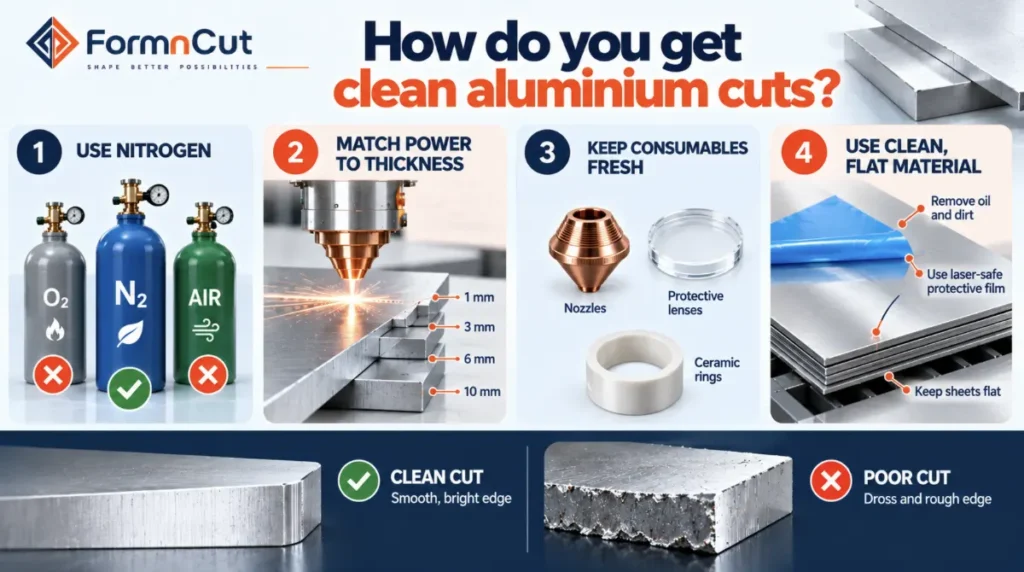
Use enough laser power for the thickness, high-pressure nitrogen as the assist gas, the correct focus position, and a clean nozzle and protective window. Most aluminium cutting problems, such as dross underneath and rough edges, come from too little gas pressure or a worn nozzle rather than the machine itself.
Use nitrogen
Nitrogen gives a bright, oxide-free edge on aluminium. It is important for you to know that oxygen isn’t used on aluminium, because it doesn’t help the cut and degrades the edge.
Match power to thickness
Thin aluminium cuts quickly at moderate power, but thicker plate needs much more. Moreover, cutting thick aluminium at the edge of a machine’s capability usually shows up as dross and slow speeds.
Keep consumables fresh
Spatter from aluminium can foul the nozzle and protective window quickly. Regular replacement from laser cutting machine accessories such as nozzles, ceramic rings and protective lenses is cheaper than the rework a dirty head causes.
Clean, flat material
Protective films, oil and warped sheets all affect the cut. Go for clean, flat sheets and check whether the film is designed for laser cutting.
Which fiber laser machine suits aluminium work?
The right machine depends on the sheet size you buy, the thickness of aluminium you cut, and the volume you run. Compact machines suit small precise parts; large-format machines with higher power suit full sheets and thicker plate.
Small, precise parts
For small aluminium components, a compact machine is efficient and easy to fit into a workshop. The Precision Fiber Laser Cutting Machine has cutting areas from 600 x 400 mm to 600 x 900 mm with 1,000 W to 3,000 W sources, and is built for stainless steel, mild steel, aluminium and copper.
Full sheets and thicker plate
For full-size sheets and thicker aluminium, a larger machine with more power is the better fit. The Indra range covers cutting areas from 3000 x 1500 mm up to 12000 x 2500 mm, with laser output from 1,500 W to 30,000 W.
Mixed metals
Most shops cut aluminium alongside steel. Moreover, a fiber laser handles both on the same machine, with only the gas and parameters changing between jobs.
What should you ask before buying a laser cutting machine for aluminium?
Ask for a sample cut on your alloy and thickness, the recommended source power, the gas consumption at that thickness, the cutting speed, and the local service response for the source and head. These answers tell you how the machine will perform and what it’ll cost to run on your work.
Sample cuts
A sample on your own part is the most honest test. Ask FormNCut or any supplier you’re considering to cut your part, so you can check the edge, the dross and the speed before deciding.
Running costs
Nitrogen consumption on aluminium can be significant. It is recommended that you ask for gas use per hour at your typical thickness, because it’s often the biggest running cost after electricity.
Service and support
The source and cutting head need expert support when something goes wrong. A supplier with a local service network keeps downtime short.
Wrapping up
A fiber laser cutting machine makes its beam inside a doped fiber, carries it to the head through a flexible cable, focuses it to melt the metal, and uses assist gas to clear the cut while the CNC moves the head. That design is what made aluminium cutting routine: fiber wavelengths are absorbed far better than CO2, and with nitrogen and the right power, aluminium edges come out clean and bright. To see how your aluminium parts would cut, ask our team for a sample cut.
FAQs
How does a fiber laser cutting machine work?
Diodes pump light into a doped optical fiber that generates a laser beam. A fiber cable carries it to the cutting head, which focuses it to melt metal, while assist gas clears the cut and the CNC moves the head.
Can a fiber laser cut aluminium?
Yes. Fiber lasers cut aluminium routinely because aluminium absorbs their shorter wavelength far better than the longer CO2 wavelength. Nitrogen assist gas and adequate power for the thickness give clean, bright edges.
Which gas is used for laser cutting aluminium?
Nitrogen is the standard assist gas for laser cutting aluminium. It blows the molten metal out of the kerf and prevents oxidation, leaving a clean edge. Oxygen isn’t used on aluminium.
Why is aluminium harder to laser cut than steel?
Aluminium reflects more laser light, conducts heat away much faster, and has a tough surface oxide. It therefore needs a fiber laser, more power per millimetre of thickness than steel, and high-pressure nitrogen.
What laser power do I need to cut aluminium?
It depends on thickness and speed. Thin aluminium sheet can be cut at moderate power, while thicker plate needs much higher power. Ask for a sample cut on your exact alloy and thickness before choosing.
Is fiber laser better than CO2 for cutting metal?
For most sheet metal work, yes. Fiber lasers offer high beam quality, better absorption in metals like aluminium, compact design and high power efficiency, with no mirrors to align in the beam path.