

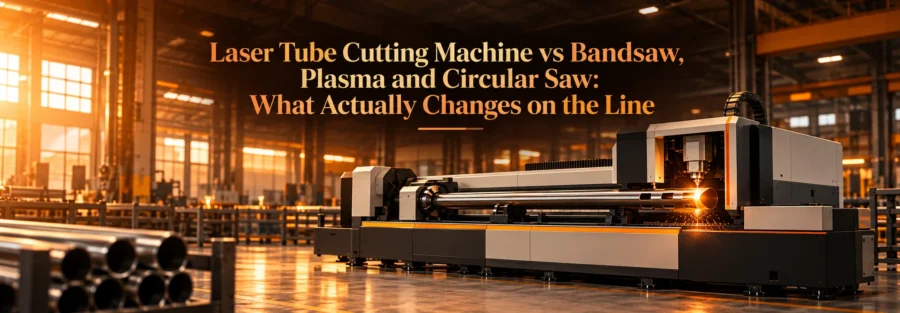
A laser tube cutting machine cuts profiles, holes, slots and copes into tube in one setup, where a bandsaw, plasma torch or circular saw cuts length only and hands the part on to a drill, a mill or a fitter. The change is not cut speed. It is the number of operations that disappear between raw tube and a part ready to weld.
Most shops comparing these four processes ask the wrong question first. They ask which one cuts faster. Cut time is rarely the constraint on a tube line, because the part is not finished when it comes off the saw.
Walk the floor instead. Count how many times a tube gets picked up, clamped, measured and put down between the stock rack and the welding bay. That count is the number a laser changes.
India consumed 163.7 million tonnes of finished steel in 2025-26, up 7.6 per cent, and a growing share of that goes into fabricated structures where tube ends have to fit each other properly. That is the pressure behind this decision.
What does each process actually do to a tube?
Each of the four separates tube into lengths, but only one of them produces features while it does so. A bandsaw, circular saw and plasma torch all deliver a cut face and nothing else. A laser tube cutting machine delivers the cut face plus every hole, slot, cope and marking the part needs, positioned from the same datum.
| Process | Produces | Typical cut face | Secondary work needed |
| Bandsaw | Length, mitre | Clean, some burr | Drill, notch, cope, deburr |
| Circular saw | Length, mitre | Very clean | Drill, notch, cope |
| Plasma | Length, rough profiles | Dross, wide heat zone | Grind, drill, often re-square |
| Laser tube cutting | Length, holes, slots, copes, marking | Burr free, narrow heat zone | Usually none before welding |
That last column is the whole argument. Everything else is detail.
Where does a bandsaw still win?
On thick solid section, on very large diameters, and on a shop that cuts long runs of plain lengths and nothing else.
A bandsaw is cheap to buy, cheap to run, and almost anyone can be taught to operate one in a morning. If your work is cutting 200 identical lengths of 100 mm box section with no holes in them, a laser is an expensive way to do a simple job.
The bandsaw stops making sense the moment somebody has to mark and drill those 200 pieces afterwards. Two operations become one, and the second operation is where the tolerance drifts.
Circular and cold saws sit in a similar place with a better cut face. They are excellent at what they do and they still do only one thing.
Why does plasma cost more than it looks?
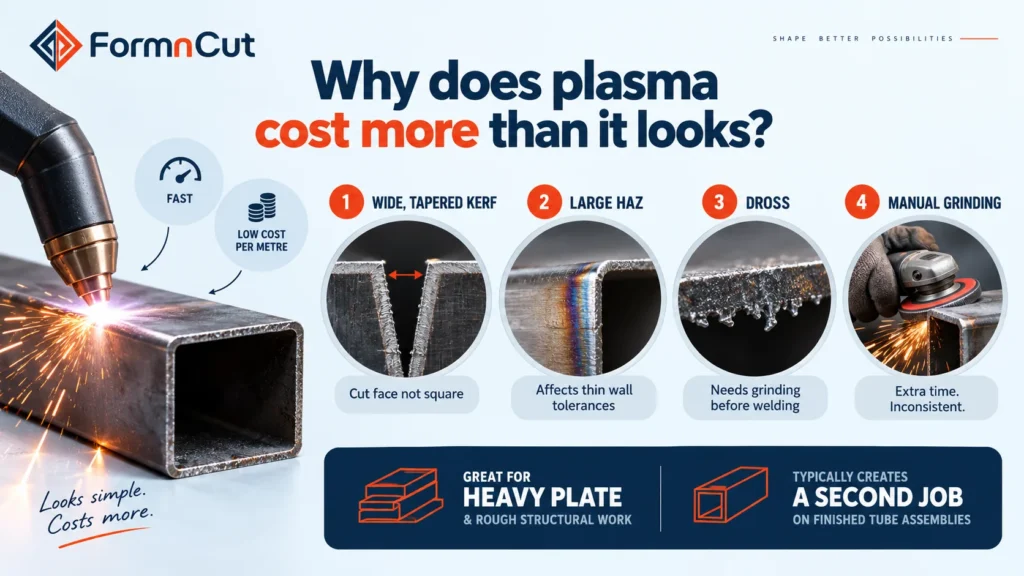
Plasma is fast and it is cheap per metre, and on tube it carries three costs that do not appear on a quotation.
The kerf is wide and tapered, so the cut face is not square without secondary work. The heat affected zone is broad, which matters on thin wall tube that then has to hold a tolerance. And dross has to be ground off before anything is welded to that face.
Grinding is the hidden line item. It is manual, it is inconsistent between operators, and nobody logs it as a cost of cutting, because it happens at a different bench.
Plasma earns its place on heavy plate and on rough structural work. On finished tube assemblies it usually creates a second job.
What decides cut quality on a fibre laser?
Cut quality on a fibre laser is set by parameters, not by operator skill, which is precisely why it repeats. Research on fibre laser fusion cutting of stainless steel identifies laser power, focal plane position, cutting gas pressure, nozzle stand-off distance and nozzle diameter as the factors governing kerf geometry and cut edge roughness.
Read that list again. Every item on it is a number stored in a program. None of them is a person’s judgement on a Friday afternoon.
That is the real difference between a laser and a saw on a busy line. The tenth part matches the first because the settings did not change, and the settings did not change because nobody had to set them by hand.
The Indra range of tube cutting machines runs on that principle, with intelligent cutting software, imported servo motors and automatic lubrication, across models from FTC-6012 to FTC-6052 covering 6000 x 120 mm up to 6000 x 520 mm.
How do you work out whether the change pays?
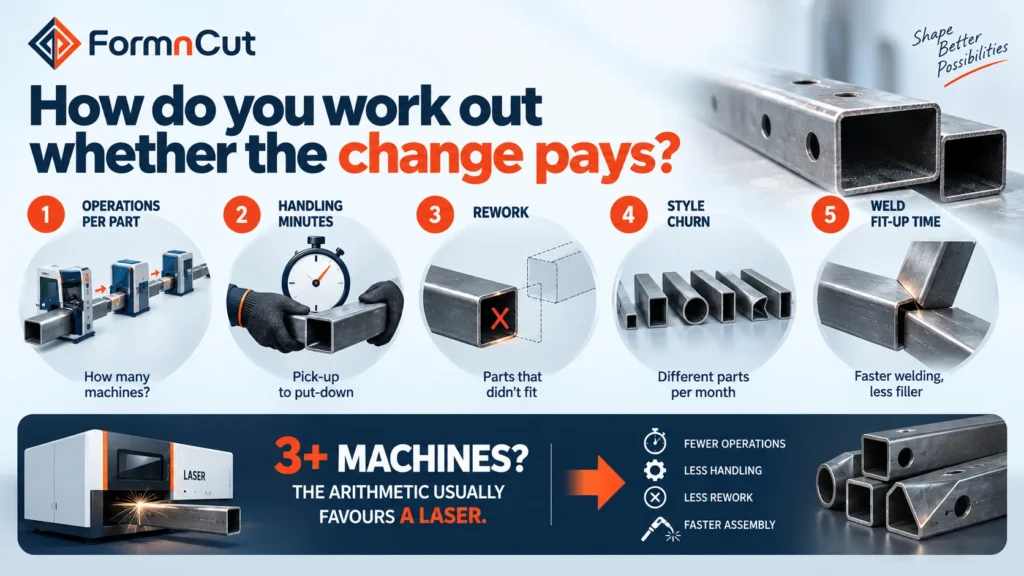
Stop counting cut time. Count operations, handling and rework instead.
- Operations per part. How many machines does one tube visit between the rack and the weld bay? Every one of those is a setup, a queue and a chance to lose the datum.
- Handling minutes per part. Time a tube from pick-up to put-down across the whole route, not just the seconds it spends being cut.
- Rework traced to cutting. Parts that did not fit at assembly, and how many of those trace back to a hole drilled from the wrong reference face.
- Style churn. How many different tube parts you cut in a month. Churn is where fixed tooling and manual marking quietly cost the most.
- Weld fit-up time. A coped tube end that fits drops welding time and filler consumption, and that saving sits in a different department’s budget.
If your answer to point one is three or more machines, the arithmetic usually favours a laser before anyone has argued about cut speed.
Machines built for Indian tube shops
FormNCut is a brand of Stamp’IT Robotai & Solutions Pvt. Ltd., an ISO 9001:2015 company based at Wagle Industrial Estate in Thane, with more than five decades of group engineering behind it and customers in over 40 countries. The group built MarknStamp for marking and traceability before launching FormNCut for laser cutting in 2025.
The range covers fibre laser tube cutting, the fibre laser automatic pipe cutting machine with automatic loading and unloading, tube and plate integrated systems, press brakes and panel benders, supplied with installation and after-sales support rather than a handover at the door.
Every tube shop is a different mix of section sizes, wall thicknesses and part complexity, so the useful conversation is about your parts rather than a spec sheet. Send across a drawing of the tube part you make most often, and talk to an engineer about what your line would actually save.
Frequently asked questions
Is a laser tube cutting machine faster than a bandsaw?
Not always on a plain cut. A laser tube cutting machine wins on total time because it produces holes, slots and copes in the same setup, removing the drilling and notching operations that follow a saw cut.
Can a laser tube cutter handle square and rectangular sections?
Yes. Fibre laser tube machines cut round, square, rectangular and special profile sections, with the chuck rotating the section under the head so features can be placed on any face from one datum.
Does plasma cutting work on thin wall tube?
Poorly. Plasma has a wide kerf and a broad heat affected zone, which distorts thin wall tube and leaves dross that must be ground before welding. Laser or saw cutting suits thin wall sections far better.
What tube sizes can these machines cut?
The Indra FTC range covers 6000 x 120 mm through to 6000 x 520 mm cutting ranges across six models. The automatic pipe cutting machine handles 20 mm to 350 mm diameters at up to 6 metres length.
Do I still need a saw if I buy a tube laser?
Many shops keep one. A saw remains useful for heavy solid bar, oversized sections beyond the laser’s chuck capacity, and quick one-off cuts that are not worth programming.
The honest test is not which process cuts a tube fastest. It is how many people touch that tube before it reaches the welder, and whether the hole in it lines up when it gets there. Check the full FormNCut tube cutting range and talk to an engineer about the parts your line actually runs.