
By FormNCut | 9 min read
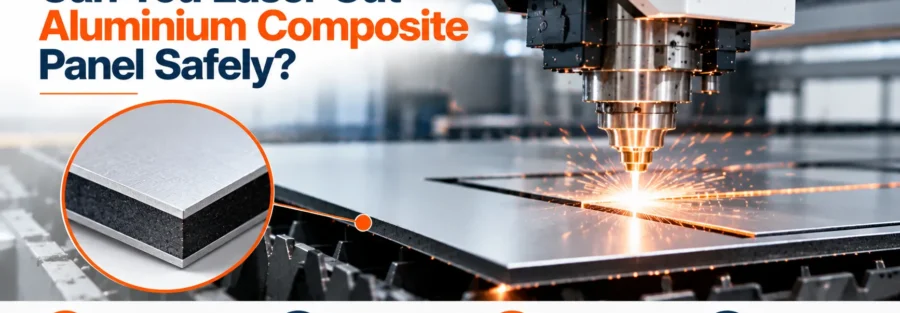
In most cases, you shouldn’t laser cut aluminium composite panel (ACP). Standard ACP has a polyethylene core between two thin aluminium skins, and a laser that’s powerful enough to cut the aluminium melts and can ignite the plastic core, releasing fumes and creating a fire risk inside the machine. The safer, standard way to fabricate ACP is CNC routing and V-grooving, followed by folding by hand or on a press brake machine, or switching to solid aluminium sheet, which lasers and press brakes handle well.
Key insights
- ACP is two materials, not one: thin aluminium skins and a plastic or plastic-mineral core that behave very differently under a laser.
- The core is the hazard: polyethylene melts, smokes and can burn under the heat needed to cut the aluminium.
- Routing and folding are the norm: ACP trays and cassettes are made by V-grooving the back skin and folding.
- Solid aluminium is the laser-friendly alternative: it cuts cleanly on a fiber laser and bends accurately on a CNC press brake.
Before you go
Before any ACP goes near a laser in your shop, check the panel’s data sheet for its core type, and check your laser supplier’s guidance on non-metal materials. If either one is unclear, don’t cut it. A routed edge costs less than a fire inside an enclosed machine.
Do you know what’s inside a sheet of ACP? It looks like aluminium from both sides, but most of its thickness is a core of plastic, or plastic mixed with mineral filler. According to a Chubb risk bulletin on aluminium composite panels, panels are typically 4 to 6 mm thick, with a 3 to 5 mm core between two skins of about 0.5 mm aluminium, and the core is generally 100% polyethylene or a mix of polyethylene and mineral fibre.
So what this means is that when you point a laser at ACP, you’re mostly cutting plastic. That’s the root of every problem with laser cutting it.
This guide explains why laser cutting ACP is risky, what the safer fabrication route is, where press brakes fit in, and when solid aluminium makes more sense.
Why is laser cutting ACP a problem?
Laser cutting ACP is a problem because the aluminium skins and the plastic core need completely different treatment. Aluminium needs high laser power to cut, while polyethylene melts, chars and can catch fire at far lower energy. Settings that cut the skins cleanly overheat the core; settings gentle enough for the core won’t cut the aluminium.
Two materials, two sets of settings
One plastics supplier sums it up plainly: aluminium typically needs 500 W or more for a clean cut on 3 mm, while polyethylene warps or melts under high power, so laser cutting ACP is largely impractical. Moreover, the result is often a melted, bubbled core edge with poor finish.
Fire risk inside the machine
Molten plastic and an oxygen-rich assist gas are a dangerous combination. It is important for you to know that burning core material inside an enclosed cutting area can damage the machine and endanger people nearby.
Edge quality
Even when a cut goes through, the core tends to melt back and leave a ragged, discoloured edge. That edge is weaker and looks poor on a facade.
| Issue | What happens | Why it matters |
| Different materials | Aluminium needs high power, PE melts at low energy | No setting suits both |
| Core ignition | PE can burn under laser heat | Fire risk inside the machine |
| Fumes | Melting plastic releases smoke and particles | Operator exposure, extraction load |
| Edge finish | Melted, bubbled core | Poor appearance, weaker edge |
| Machine contamination | Plastic residue on optics and bed | Extra cleaning and downtime |
What fumes does cutting ACP release?
Cutting the polyethylene core with heat releases smoke, gases and very fine particles. Research on laser cutting plastics found that significant concentrations of nanoplastic and microplastic particles were released each time a laser cutter lid was opened, and that concentrations kept rising for at least 20 minutes after a cut.
Fumes from the core
Melting or burning polyethylene produces smoke that needs proper extraction. The thing to note here is that metal-cutting extraction systems are designed for metal fume and dust, not for sticky, combustible plastic residue.
Fine particles
Very small particles can stay in the air for some time after a cut. Moreover, operators are most exposed when they open the enclosure, which is exactly when they unload parts.
Panel data sheets
Manufacturers’ safety data sheets for composite panels generally warn that cutting, melting or machining can release hazardous fumes or dust. It is recommended that you read the data sheet for the exact panel you’re using before choosing any cutting method.
Is fire-rated ACP safer to laser cut?
Fire-rated ACP, with a core that’s mostly mineral filler, is less combustible than standard polyethylene-core panel, but it still contains polymer binder and still combines two very different materials. Laser cutting it remains uncommon, and routing is still the standard fabrication method.
What changes with a mineral core
A mineral-filled core resists burning better. However, the polymer in it still melts and smokes, and the mineral filler can be abrasive and dusty.
What doesn’t change
The skins and core still need different settings. You might not be aware, but even fire-rated panels are usually fabricated by routing and folding, because that’s what gives the cleanest, most consistent trays.
Check the classification
Fire-rated panels vary by manufacturer and classification. Go for the manufacturer’s fabrication guide rather than assuming any panel is safe to laser cut.
| Panel type | Core | Laser cutting | Standard fabrication |
| Standard ACP | 100% polyethylene | Not recommended | Route, V-groove, fold |
| Fire-rated ACP | Mostly mineral filler with polymer | Uncommon, still not standard | Route, V-groove, fold |
| Solid aluminium sheet | Solid metal | Well suited to fiber laser | Laser cut, then bend on a press brake |
How is ACP normally cut and folded?
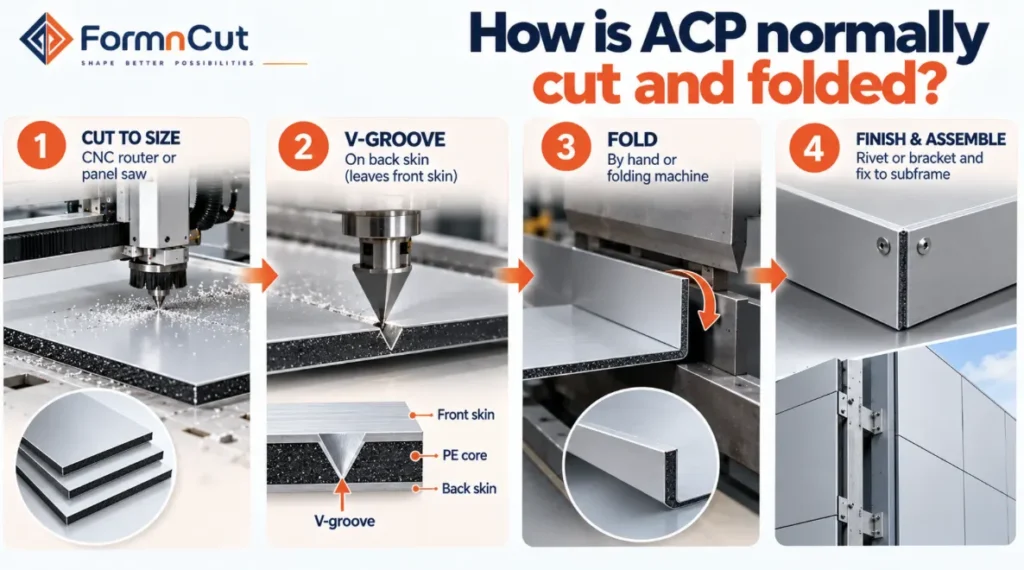
ACP is normally cut with a CNC router or panel saw, then V-grooved on the back skin and folded along the groove to make trays, cassettes and returns. The front skin bends around the groove while the core stays intact, which gives a crisp, consistent corner.
Routing and V-grooving
A router cuts the outline and machines a V-shaped groove through the back skin and most of the core, leaving the front skin and a thin layer of core. Moreover, routing produces chips rather than molten plastic, which is far easier to manage safely.
Folding
Once grooved, the panel folds easily along the line. Light folds can be done by hand on a bench; for consistent, repeatable trays, many fabricators use a folding machine or a press brake with suitable tooling and low force.
Corner finishing
Corners are riveted or fixed with brackets, and the panels are hung on a subframe. It is recommended that you follow the panel manufacturer’s minimum groove and bend guidance, because a groove that’s too deep weakens the fold.
Where does a press brake fit into cladding work?
A press brake fits into cladding work in two places: folding grooved ACP trays consistently, and bending solid aluminium and steel parts like brackets, subframe channels, flashings and solid aluminium cassettes. A CNC press brake makes these bends repeatable across hundreds of identical panels.
Folding grooved trays
With the right tooling and low tonnage, a press brake can fold grooved ACP accurately and consistently. Moreover, CNC back gauges position each fold the same way every time.
Brackets, channels and flashings
Every cladding system needs metal brackets, channels and flashings. These are classic press brake parts, and accuracy here decides how well the panels line up on the building.
Solid aluminium cassettes
Solid aluminium cladding cassettes are laser cut flat, then folded on a press brake. FormNCut’s CNC press brake machines use automatic compensation for slider deformation, which keeps long bends straight along the full length of a panel.
| Cladding part | Material | Cut with | Bend with |
| ACP trays and cassettes | ACP | CNC router, V-groove | Hand fold, folder or press brake |
| Solid aluminium cassettes | Aluminium sheet | Fiber laser | CNC press brake |
| Brackets and cleats | Aluminium or steel | Fiber laser | CNC press brake |
| Subframe channels | Aluminium or galvanised steel | Fiber laser or saw | Press brake or roll former |
| Flashings and trims | Aluminium or steel | Fiber laser | Press brake |
[Image: a CNC press brake folding a long solid aluminium cladding cassette, with a stack of finished cassettes on a trolley beside it. Caption: Solid aluminium cassettes are laser cut flat and folded on a press brake, which is where accurate long bends matter most.]
When should you switch from ACP to solid aluminium?
Switch to solid aluminium when the project needs a non-combustible facade, when you want to laser cut patterns, perforations or complex shapes, or when the client wants a longer-life, fully recyclable panel. Solid aluminium is heavier and costs more per square metre, but it’s simpler and safer to fabricate on laser and press brake equipment.
Non-combustible facades
Many projects now specify non-combustible cladding, especially on taller buildings. Moreover, solid aluminium meets that requirement without depending on a core’s fire rating.
Laser-cut patterns and perforations
Decorative screens, perforated facades and cut-out signage are natural fiber laser work on solid aluminium. You can’t do the same safely on standard ACP.
Fabrication on one line
Solid aluminium goes from laser to press brake to finishing on standard sheet metal equipment. Fabricators working on facades and buildings can see how this fits into construction and infrastructure work.
How do you choose the right bending setup for cladding?
Choose a press brake with enough bed length for your longest panels, CNC control with a multi-axis back gauge for repeatable folds, crowning or deflection compensation for straight long bends, and tooling suited to thin aluminium. For high volumes of panels with many folds, a panel bender can be faster still.
Bed length and tonnage
Cladding panels can be long, so bed length matters more than tonnage for thin aluminium. It is recommended that you size the machine for your longest panel with some margin.
Tooling
Thin aluminium marks easily, so tooling with suitable radii and protective film helps keep visible faces clean. FormNCut supplies bending tools for different profiles and materials.
Electric or hydraulic
For thin-gauge, high-precision work, an electric press brake offers quiet, energy-efficient operation. The Pure Electric Press Brake suits this kind of light, accurate bending.
Wrapping up
Laser cutting standard ACP isn’t a safe or practical choice: the polyethylene core melts, smokes and can burn at the power needed to cut the aluminium. Fabricate ACP the standard way, by routing, V-grooving and folding, and use a press brake for consistent folds, brackets and flashings. When a project needs laser-cut shapes or a non-combustible facade, switch to solid aluminium, which a fiber laser and a CNC press brake handle well. To discuss the right bending setup for your cladding work, talk to our team.
FAQs
Can you laser cut ACP sheet?
It isn’t recommended. Standard ACP has a polyethylene core that melts, smokes and can ignite at the laser power needed to cut the aluminium skins. CNC routing is the standard and safer method.
What is the core of aluminium composite panel made of?
ACP cores are generally either 100% polyethylene or a mix of polyethylene and mineral fibre, between two aluminium skins of about 0.5 mm. Fire-rated panels use a mostly mineral-filled core.
How is ACP cut and folded?
ACP is cut with a CNC router or panel saw, then V-grooved through the back skin and most of the core. It’s then folded along the groove by hand, on a folder or on a press brake.
Can a press brake bend ACP?
Yes, a press brake with suitable tooling and low force can fold grooved ACP into trays and cassettes consistently. Ungrooved ACP is harder to bend cleanly, so V-grooving first is standard practice.
Is fire-rated ACP safe to laser cut?
Fire-rated ACP is less combustible, but it still contains polymer binder and combines two different materials. Laser cutting it isn’t standard practice, and CNC routing remains the recommended fabrication method for these panels.
What can I use instead of ACP for laser-cut facades?
Solid aluminium sheet is the usual alternative. It’s non-combustible, laser cuts cleanly into patterns and perforations, and bends accurately on a CNC press brake into cassettes, flashings and trims.