
On a laser cutting machine for tube, the beam is busy for a minority of the cycle. Loading the section, closing the chucks, indexing the remnant and clearing the finished part take the rest. Output per shift is set by how those four handling steps are automated, not by the wattage on the nameplate.
Ask a supplier how fast their machine cuts and you will get a number in metres per minute. Ask how many parts it makes in an eight hour shift and the answer gets vaguer, because that answer depends on your floor, not their laboratory.
The gap between those two numbers is handling.
Why is cut speed the wrong number to buy on?
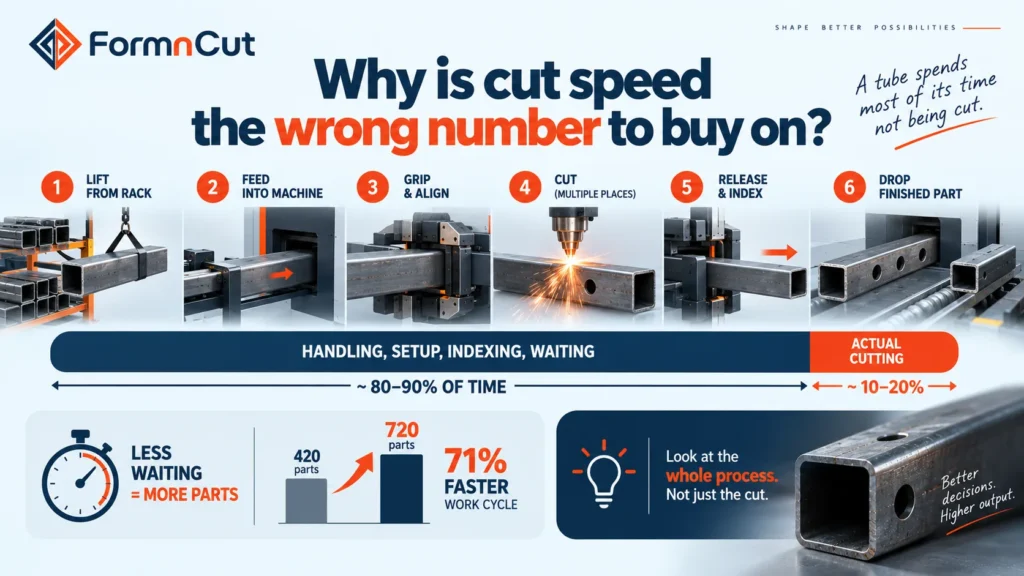
Because a tube spends most of its time on the machine not being cut.
A six metre length has to be lifted from the rack, fed into the machine, gripped, aligned, cut in several places, released, indexed forward, re-gripped, and finally dropped clear as a finished part with the remnant separated. The beam fires for a fraction of that sequence.
This is a well documented pattern across manufacturing. Work-study research on a metal fabrication line found that removing idle time from three punching machines, with no capital investment at all, raised output from 420 to 720 pieces in eight hours and cut the work cycle by 71 per cent, from 65 seconds to 39.
No new machine. No more power. Just less waiting.
Formal manufacturing KPI frameworks treat this the same way. The NIST hierarchy of manufacturing performance indicators defines load and unload time as part of a machine’s busy time, separating actual processing time from delay and setup time, precisely because the two behave differently.
If you measure only the cutting, you are measuring the part of the shift you already optimised.
What happens at each stage of the cycle?
Five stages, and each has a different failure mode.
Loading. The tube moves from the bundle rack into the feed axis. Done by hand, this is two people, a lifting risk and a queue. An automatic loader takes a section from a bundle and presents it without an operator, which means the machine can keep running while nobody is standing at it.
Chucking. The chuck grips the section and holds concentricity through the cut. This is where accuracy is won or lost. A section that shifts in the chuck puts every subsequent feature out of position, and the part will still look correct until it reaches assembly.
Feeding and indexing. The tube advances through the machine between cuts. On long sections this happens repeatedly, and each index has to land on the same datum as the last.
Cutting. The beam works. This is the part everyone benchmarks.
Unloading and remnant handling. Finished parts clear the machine, and the unusable tail end is separated from good material. Get this wrong and a running machine stops because nobody emptied it.
Four of those five stages have nothing to do with the laser source.
Where does automation actually change the arithmetic?
In three specific places, and it helps to be precise about which.
| Stage | Manual | Automated | What changes |
| Loading | Operator lifts and feeds | Bundle loader feeds continuously | Machine runs unattended between bundles |
| Chucking | Manual clamp and check | Programmed chuck, sensed | Repeatability stops depending on the operator |
| Remnant | Measured and cut by eye | Remnant system tracks and reports | Offcut length drops, material yield rises |
| Unloading | Operator clears each part | Automatic unload to conveyor or bin | No stoppage waiting for the bench to clear |
The remnant line is the one buyers underestimate. On a shop cutting six metre sections all day, the difference between a 400 mm offcut and an 800 mm offcut compounds across every bar in every bundle, and material is the largest cost in most tube fabrication.
The fibre laser automatic pipe cutting machine is built around this, with an automatic loading and unloading system, optional shuttle tables, and CNC control integrated with CAD and CAM, cutting round, square, rectangular and custom profile pipes from 20 mm to 350 mm diameter at up to six metres.
What should you measure on your own floor first?

Before comparing any two machines, spend one shift with a stopwatch and answer four questions.
- What percentage of the cycle is the beam actually on? Time it across twenty parts. Most shops are surprised by how low this is.
- How many operator interventions per bar? Every intervention is a chance for the machine to sit idle waiting for a person.
- What is your average remnant length? Multiply it by the number of bars per month and price the steel.
- How long does the machine sit full? Time between a part finishing and the machine being clear to start the next one.
Those four numbers tell you whether you need a bigger laser or better handling. Frequently it is the second, and the second is cheaper.
Machines built to run unattended
FormNCut is a brand of Stamp’IT Robotai & Solutions Pvt. Ltd., an ISO 9001:2015 company operating from Wagle Industrial Estate, Thane, carrying more than fifty years of group engineering experience and serving customers in over 40 countries.
The tube range is designed for mass production conditions rather than for a demonstration. The Indra range carries automatic feeding and remnant material systems, automatic lubrication and imported servo motors, and the group supports installation and after-sales service directly rather than through a call centre.
Every line loses time somewhere different, so the useful exercise is measuring yours rather than reading a specification. Send across your part mix and your section sizes, and talk to an engineer about where the shift is actually going.
Frequently asked questions
What is an automatic pipe cutting machine?
A laser cutting machine for tube with automated loading, chucking, feeding and unloading, so sections move through the machine without an operator handling each one. This lets the machine run continuously between bundle changes.
Does automatic loading work with mixed section sizes?
Yes, within the machine’s chuck range. Changeover between sizes needs a program change and sometimes a chuck adjustment, so shops usually batch similar sections together to minimise how often that happens.
How much material does remnant control actually save?
It depends on your section cost and volume. The saving is the difference between your current average offcut length and the machine’s, multiplied by every bar you cut, which on high volume lines is significant.
Can one operator run more than one machine?
Often yes, once loading and unloading are automated. The operator’s role shifts from feeding the machine to managing programs, material supply and quality checks across several machines.
What diameter range can these machines handle?
The automatic pipe cutting machine covers 20 mm to 350 mm diameters, customisable, at cutting lengths up to six metres with extendable options, holding accuracy of plus or minus 0.1 mm with burr free edges.
The machine that wins on a spec sheet is not always the machine that wins on your floor, because your floor has queues, lifting and a bench that fills up. Check the FormNCut automatic pipe cutting range and talk to an engineer about the handling, not just the beam.